Face-Tracking Phone Mount
A self-made robotic phone mount that will use computer vision to detect a face and rotate to keep it centered in frame, without needing to be held or repositioned by hand.
- Role
- Solo Build
- Timeline
- 2026 – Present
- Status
- In Progress
- Stack
- Raspberry Pi Zero, Motors, OpenCV
Overview
This started from an annoying, everyday problem: propping a phone up for a video call or a workout and then having to keep nudging it back into frame every time I moved. I wanted something that would just watch for my face and keep it centered on its own. Further out, I think the same idea could help someone with limited mobility or dexterity set a phone up once instead of repositioning it by hand every few minutes.
The finished device is a robotic phone mount: a phone sits on a pan platform, a camera feed detects a face, and the mount rotates left and right to keep that face centered as the person moves.
My Role
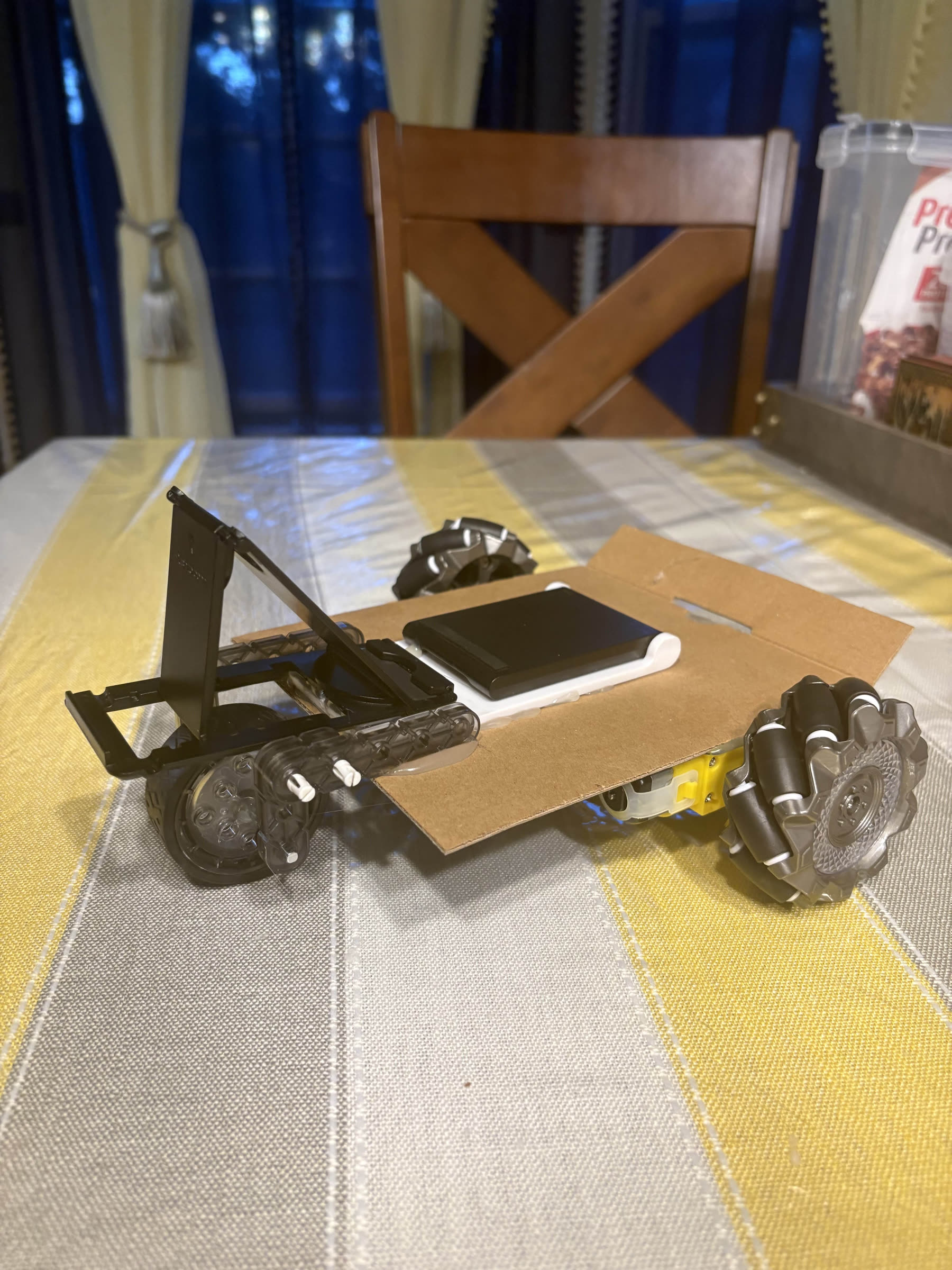
I'm building this alone, so everything so far has been on me: working out how the pan mechanism should move, picking the motors and electronics, and now redesigning the mechanical side as a 3D-printed version instead of the cardboard rig I started with.
The first version was cobbled together from cardboard and whatever else was around the house, just to check that two motors and a pair of mecanum wheels (standing in for a real bearing) could actually rotate the platform smoothly. That worked, so I moved on to a proper 3D-printed design built around a Raspberry Pi Zero. The vision and control software haven't been written yet.
Technical Approach
The mount only pans left and right; there's no tilt axis. Two motors drive the rotation, and a pair of mecanum wheels take the place of a dedicated bearing to support and turn the platform, with a Raspberry Pi Zero acting as the onboard controller.
Right now all of that is built from cardboard and household parts, good enough to prove the mechanism but not to build on. I'm redesigning it as a 3D-printed version sized to be something repeatable, not a one-off held together with tape.
Face detection is the next piece: reading the camera feed, finding a face, and converting its position into motor commands. None of that exists yet.
Challenges
The cardboard version was built to answer one question — does the mechanism work — not to hand off clean dimensions. Turning it into something 3D-printed means re-measuring the motor mounts and wheel base from scratch instead of just scaling up what I taped together. That precision matters more here than on a purely cosmetic part, because any slop in the geometry throws off how true the mecanum wheels track when the mount turns.
Current Status & Next Steps
The mechanism itself is proven: two motors and mecanum wheels can pan a platform smoothly. What's left is finishing the 3D-printed rebuild, then the vision and control side (detecting a face and turning its position into motor commands), which I haven't started yet.