Mettler Toledo: R&D Intern
Designed and validated pressure-sensor connectors in PTC Creo, reducing pressure leakage by 80% for previously leaking sensors across controlled bench testing.
- Role
- R&D Intern
- Timeline
- Dec 2025 – Jan 2026
- Status
- Completed
- Stack
- PTC Creo, DV/DVT
Overview
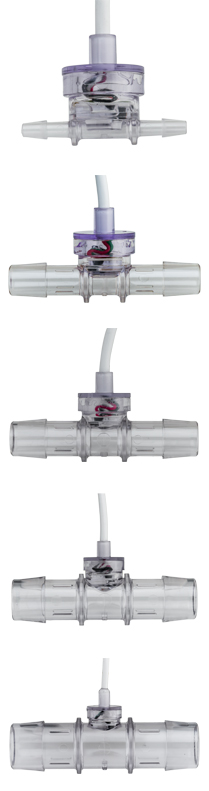
Mettler Toledo designs and manufactures precision measurement and sensing instrumentation, and PendoTECH, the brand whose sensor is pictured above, makes single-use pressure sensors used inline in biopharmaceutical manufacturing, where a leak isn't just a bench-test failure but a potential contamination path in a regulated production line. As an R&D intern on the sensor hardware team, I worked on a connector redesign for pressure sensors that were exhibiting leakage during bench testing.
The specific connector I worked on is proprietary, so I can't show the actual CAD or hardware here. The photo above is a PendoTECH single-use pressure sensor, included just to give a sense of the hardware category: an inline sensor with barbed tube connectors on either end, where seal quality at the connector is exactly the kind of thing that determines whether the line leaks. Day to day, that meant splitting time between PTC Creo for the redesign itself and the bench for DV/DVT testing: iterating on CAD in the morning and pressurizing the resulting parts in the afternoon to see whether the change actually moved the needle.
My Role
I owned the connector redesign end to end, from CAD modeling and seal-feature refinement through tolerance analysis, fit verification, and design verification/validation (DV/DVT) testing on pressurized assemblies.
That started with pulling failure data from the original design to understand where in the assembly leaks were actually occurring, rather than assuming the seal geometry itself was at fault. From there I iterated on the connector's seal features in PTC Creo, ran tolerance stack-ups against the mating parts to check whether fit was contributing to the leakage, and built out a DV/DVT test protocol to validate each revision under the same pressurized conditions the sensor sees in the field.
Technical Approach
Designed and modeled pressure-sensor connectors in PTC Creo, refining seal features across 10+ iterative design revisions.
Each revision targeted a specific hypothesis about where the seal was failing rather than a blanket redesign: one round focused on the barb-to-tube interface, another on the o-ring groove's cross-sectional geometry, a later one on the mating faces' surface finish. Isolating one variable per revision was slower than reworking the whole connector at once, but it's what made it possible to say which specific change actually moved the leak rate.
Performed tolerance analysis and fit verification to improve sealing reliability, resolving 4 fit issues along the way. Ran 20+ DV/DVT cycles, collecting 6 measurements per run to compare baseline vs. updated designs and isolate failure modes.
The tolerance analysis stacked dimensional variation across every mating feature in the seal path (not just the connector itself, but the tube, the barb, and the o-ring it compressed against) to find which individual tolerances were actually eating into the design margin. Each DV/DVT cycle then pressurized a full assembly to its rated pressure, held it, and logged leak rate alongside five other measurements per run, which is what let me trace a leak back to a specific dimension instead of just confirming that a given revision leaked or didn't.
Challenges
Isolating the true root cause of leakage meant distinguishing seal-geometry issues from assembly-tolerance issues, since both could produce similar symptoms on the bench. Running DV/DVT tests across many measurement runs per iteration was what let me separate the two and target the actual fix.
Early on, a batch of parts that measured identically on a caliper produced wildly different leak rates on the bench, which ruled out any single dimension as the sole culprit and pointed toward a tolerance stack-up across multiple mating features instead. Untangling that meant holding one variable constant at a time across DV/DVT runs (testing seal geometry against a fixed assembly tolerance, then holding geometry constant while varying tolerance) rather than changing the whole connector at once and hoping the leak rate improved.
Outcome
Reduced pressure leakage by 80% for previously leaking sensors across 5 bench-test trials, and increased first-pass assembly success to 100% by resolving all 4 identified fit issues. Documented findings across 100+ tests to support data-driven R&D decisions and reduce redesign time on future connector work.